

Chapter 6
Water Procurement
STILL CONSTRUCTION
6-15. You can use stills in various areas of the world. They draw moisture from the ground and from plant material. You need certain materials to build a still, and you need time to let it collect the water. It takes about 24 hours to get 0.5 to 1 liter of water.
ABOVEGROUND STILLS
6-16. You can construct two types of aboveground stills. To make the vegetation bag still, you need a sunny slope on which to place the still, a clear plastic bag, green leafy vegetation, and a small rock (Figure 6-6).
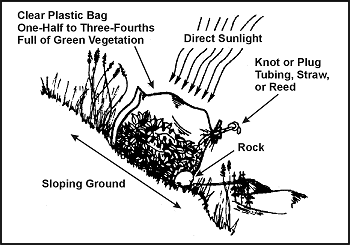
Figure 6-6. Vegetation Bag Still
6-17. To make the still, you should—
-
Fill the bag with air by turning the opening into the breeze or by "scooping" air into the bag.
-
Fill the plastic bag one-half to three-fourths full of green leafy vegetation. Be sure to remove all hard sticks or sharp spines that might puncture the bag.
-
Place a small rock or similar item in the bag.
-
Close the bag and tie the mouth securely as close to the end of the bag as possible to keep the maximum amount of air space. If you have a piece of tubing, a small straw, or a hollow reed, insert one end in the mouth of the bag before you tie it securely. Then tie off or plug the tubing so that air will not escape. This tubing will allow you to drain out condensed water without untying the bag.
|
CAUTION Do not use poisonous vegetation. It will provide poisonous liquid. |
-
Place the bag, mouth downhill, on a slope in full sunlight. Position the mouth of the bag slightly higher than the low point in the bag.
-
Settle the bag in place so that the rock works itself into the low point in the bag.
6-18. To get the condensed water from the still, loosen the tie around the bag's mouth and tip the bag so that the water collected around the rock will drain out. Then retie the mouth securely and reposition the still to allow further condensation.
6-19. Change the vegetation in the bag after extracting most of the water from it. This will ensure maximum output of water.
6-20. Making a transpiration bag still is similar to the vegetation bag, only easier. Simply tie the plastic bag over a leafy tree limb with a tube inserted, and tie the mouth of the bag off tightly around the branch to form an airtight seal. Tie the end of the limb so that it hangs below the level of the mouth of the bag. The water will collect there (Figure 6-7).
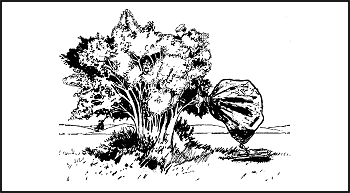
Figure 6-7. Water Transpiration Bag
6-21. The same limb may be used for 3 to 5 days without causing long-term harm to the limb. It will heal itself within a few hours of removing the bag.
BELOWGROUND STILL
6-22. To make a belowground still, you need a digging tool, a container, a clear plastic sheet, a drinking tube, and a rock (Figure 6-8).
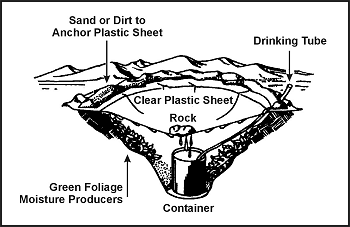
Figure 6-8. Belowground Still
6-23. Select a site where you believe the soil will contain moisture (such as a dry streambed or a low spot where rainwater has collected). The soil at this site should be easy to dig, and sunlight must hit the site most of the day.
6-24. To construct the still, you should—
-
Dig a bowl-shaped hole about 1 meter (3 feet) across and 60 centimeters (24 inches) deep.
-
Dig a sump in the center of the hole. The sump's depth and perimeter will depend on the size of the container that you have to place in it. The bottom of the sump should allow the container to stand upright.
-
Anchor the tubing to the container's bottom by forming a loose overhand knot in the tubing.
-
Place the container upright in the sump.
-
Extend the unanchored end of the tubing up, over, and beyond the lip of the hole.
-
Place the plastic sheet over the hole, covering its edges with soil to hold it in place.
-
Place a rock in the center of the plastic sheet.
-
Lower the plastic sheet into the hole until it is about 40 centimeters (16 inches) below ground level. It now forms an inverted cone with the rock at its apex. Make sure that the cone's apex is directly over your container. Also make sure the plastic cone does not touch the sides of the hole because the earth will absorb the condensed water.
-
Put more soil on the edges of the plastic to hold it securely in place and to prevent the loss of moisture.
-
Plug the tube when not in use to keep the moisture from evaporating and to keep insects out.
6-25. You can drink water without disturbing the still by using the tube as a straw. By opening the still, you release the moist, warm air that has accumulated.
6-26. You may want to use plants in the hole as a moisture source. If so, dig out additional soil from the sides of the hole to form a slope on which to place the plants. Then proceed as above.
6-27. If polluted water is your only moisture source, dig a small trough outside the hole about 25 centimeters (10 inches) from the still's lip (Figure 6-9). Dig the trough about 25 centimeters (10 inches) deep and 8 centimeters (3 inches) wide. Pour the polluted water in the trough. Be sure you do not spill any polluted water around the rim of the hole where the plastic sheet touches the soil. The trough holds the polluted water and the soil filters it as the still draws it. The water then condenses on the plastic and drains into the container. This process works extremely well when your only water source is salt water.
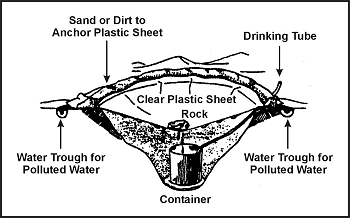
Figure 6-9. Belowground Still to Get Potable Water From Polluted Water
6-28. You will need at least three stills to meet your individual daily water intake needs. In comparison to the belowground still and the water transpiration bag still, the vegetation bag produces the best yield of water.
previous | next
All text and images from the U.S. Army Field Manual 3-05.70: Survival.
Appearance of these materials here does not constitute or represent endorsement by mongabay.com.
ProbablyHelpful.com is not responsible for inaccurate or outdated information provided by the U.S. Army Field Manual 3-05.70.